2026
NeutronSparse: Coordinating Heterogeneous Engines for Sparse Matrix Multiplication on NPUs
Xin Ai, Zeyu Ling, Hao Yuan, Qiange Wang, Yanfeng Zhang, Yutao Peng, Ge Yu
Proceedings of the International Conference on Management of Data (SIGMOD) 2027
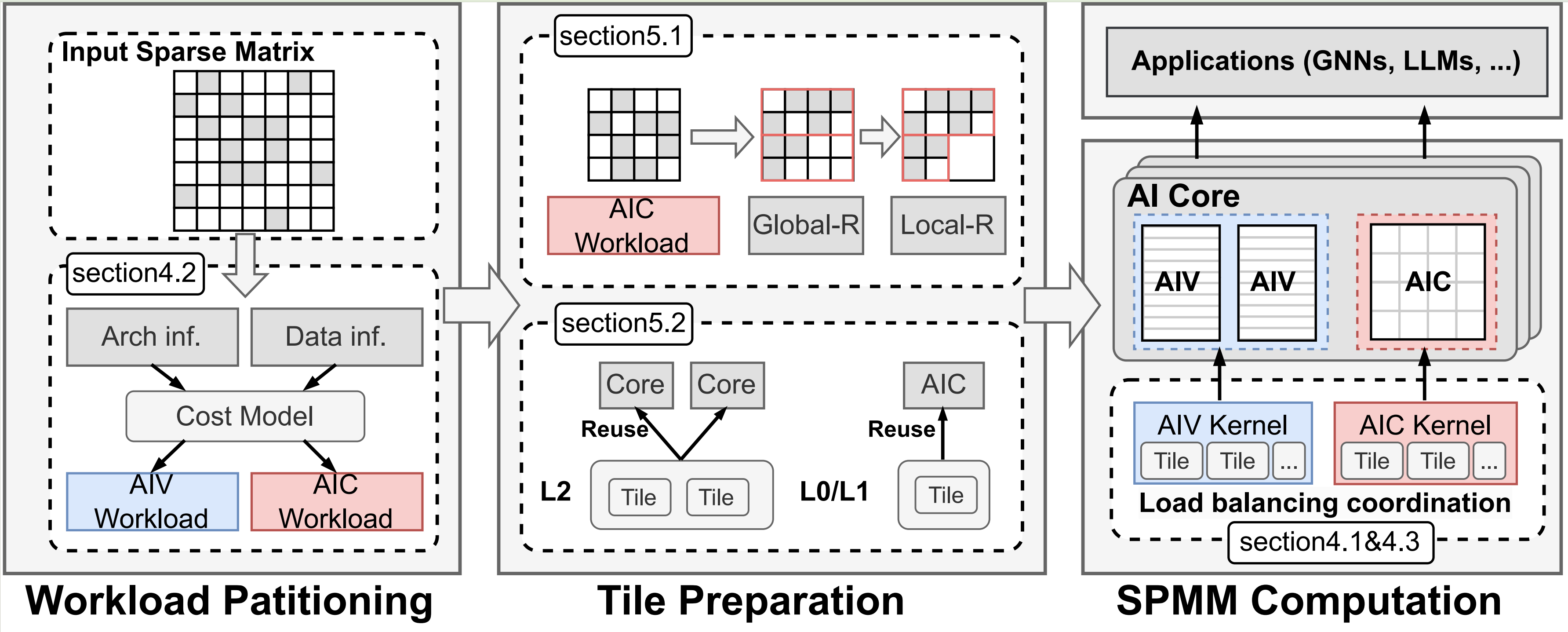
Sparse matrix–matrix multiplication is a fundamental operation for large-scale sparse data processing, but high-performance SpMM on NPUs remains challenging because irregular sparsity requires efficient data organization and scheduling across heterogeneous compute units. We identify that the main bottleneck on Ascend NPUs comes from insufficient coordination under the tile-based execution model, which limits compute utilization and causes redundant data movement. To address this, we propose NeutronSparse, a coordination-first SpMM framework that combines sparsity-aware workload balancing across heterogeneous engines with locality-aware tile orchestration to improve data reuse and execution efficiency.
NeutronSparse: Coordinating Heterogeneous Engines for Sparse Matrix Multiplication on NPUs
Xin Ai, Zeyu Ling, Hao Yuan, Qiange Wang, Yanfeng Zhang, Yutao Peng, Ge Yu
Proceedings of the International Conference on Management of Data (SIGMOD) 2027
Sparse matrix–matrix multiplication is a fundamental operation for large-scale sparse data processing, but high-performance SpMM on NPUs remains challenging because irregular sparsity requires efficient data organization and scheduling across heterogeneous compute units. We identify that the main bottleneck on Ascend NPUs comes from insufficient coordination under the tile-based execution model, which limits compute utilization and causes redundant data movement. To address this, we propose NeutronSparse, a coordination-first SpMM framework that combines sparsity-aware workload balancing across heterogeneous engines with locality-aware tile orchestration to improve data reuse and execution efficiency.
RegionCache: Semantic-Aware Region Reuse for Efficient Multi-Turn Image Generation
Peizheng Li, Xin Ai, Hanyuan Liu, Qiange Wang, Yanfeng Zhang
International Joint Conference on Artificial Intelligence (IJCAI) 2026
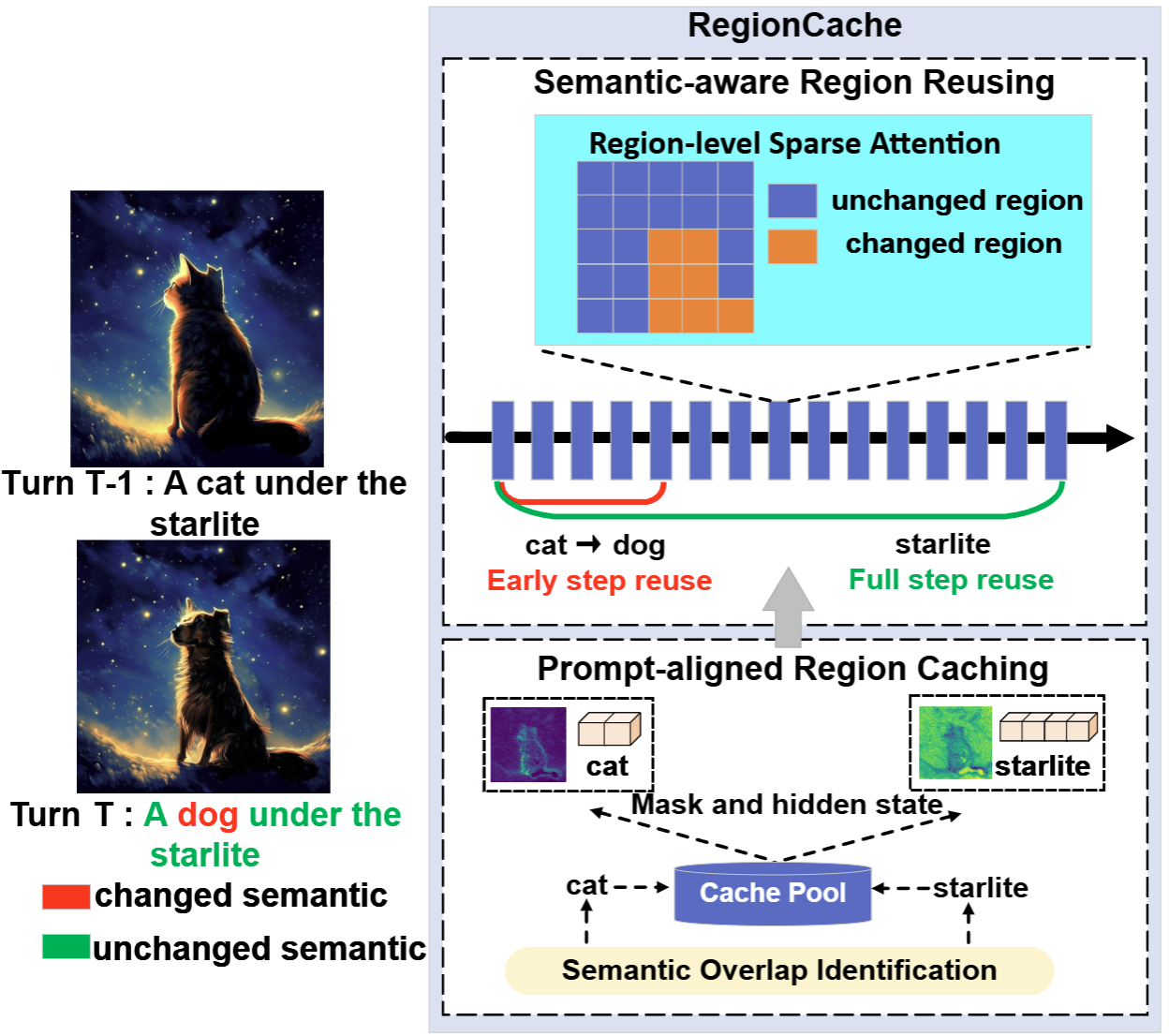
Real-world image generation often involves multi-turn editing, where only a small region changes while most of the image remains stable, yet existing DiT-based pipelines still recompute the entire image and introduce substantial redundant computation. Existing caching methods further fail to capture semantic correspondence across prompts, which can cause either unnecessary recomputation or unsafe reuse. We propose RegionCache, a semantic-aware reuse framework for multi-turn image editing that selectively reuses diffusion states from unchanged regions. RegionCache detects reusable regions through semantic overlap between consecutive prompts and cross-attention-based spatial localization, and uses an adaptive reuse schedule to control how long cached regions can be safely reused.
RegionCache: Semantic-Aware Region Reuse for Efficient Multi-Turn Image Generation
Peizheng Li, Xin Ai, Hanyuan Liu, Qiange Wang, Yanfeng Zhang
International Joint Conference on Artificial Intelligence (IJCAI) 2026
Real-world image generation often involves multi-turn editing, where only a small region changes while most of the image remains stable, yet existing DiT-based pipelines still recompute the entire image and introduce substantial redundant computation. Existing caching methods further fail to capture semantic correspondence across prompts, which can cause either unnecessary recomputation or unsafe reuse. We propose RegionCache, a semantic-aware reuse framework for multi-turn image editing that selectively reuses diffusion states from unchanged regions. RegionCache detects reusable regions through semantic overlap between consecutive prompts and cross-attention-based spatial localization, and uses an adaptive reuse schedule to control how long cached regions can be safely reused.
NeutronJittor: Efficient CPU-GPU Memory Management for GNN Training with Jittor
Shizhan Lu, Zhenbo Fu, Qiange Wang, Yanfeng Zhang, Yuehao Xu, Xin Ai, Zhewei Wei, Ge Yu
Fundamental Research 2026
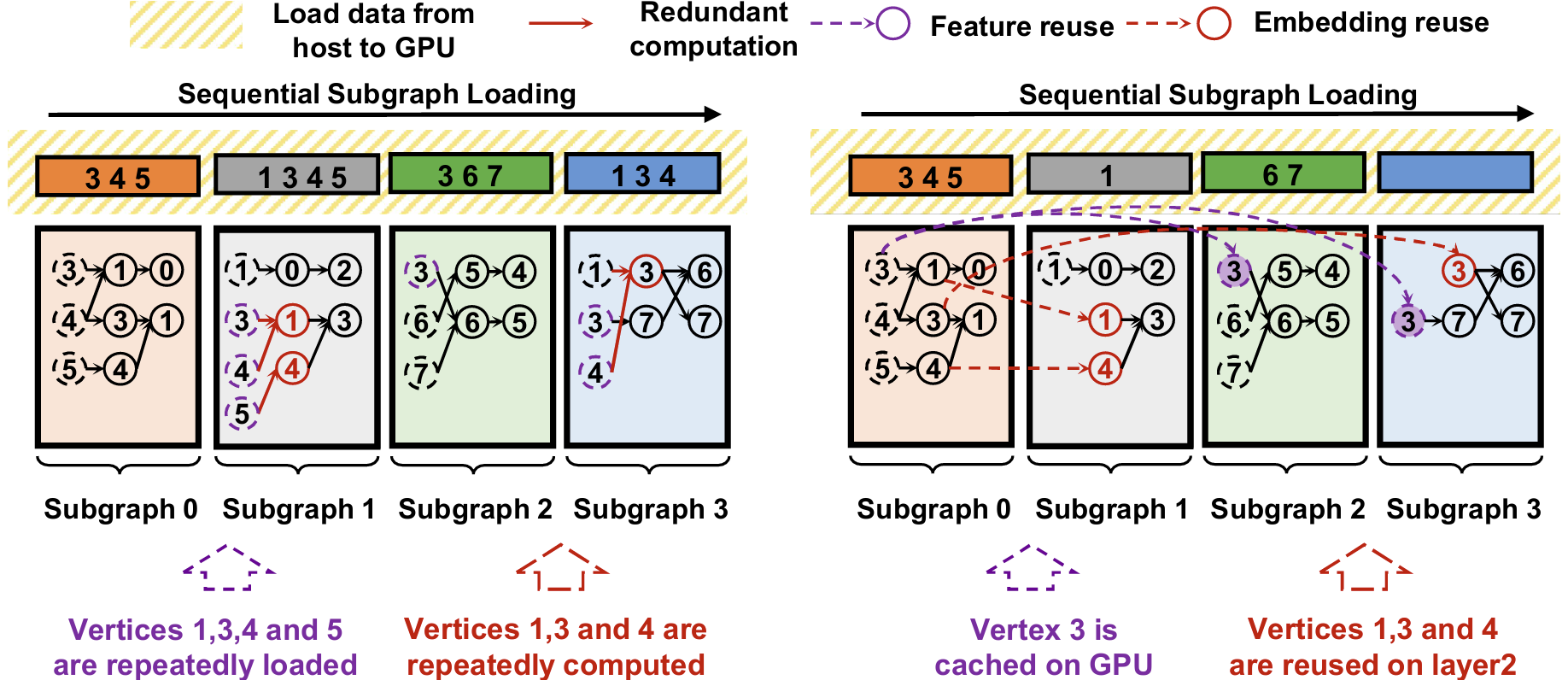
Full-graph GNN training often provides better accuracy and stability, but its large memory footprint and irregular graph access patterns make user-transparent memory management on GPUs inefficient. We propose NeutronJittor, a GNN training system that reduces redundant computation through embedding reuse across shared vertices within an epoch and lowers CPU–GPU data movement with a spatial–temporal-aware scheduler that keeps high-priority vertex data on the GPU.
NeutronJittor: Efficient CPU-GPU Memory Management for GNN Training with Jittor
Shizhan Lu, Zhenbo Fu, Qiange Wang, Yanfeng Zhang, Yuehao Xu, Xin Ai, Zhewei Wei, Ge Yu
Fundamental Research 2026
Full-graph GNN training often provides better accuracy and stability, but its large memory footprint and irregular graph access patterns make user-transparent memory management on GPUs inefficient. We propose NeutronJittor, a GNN training system that reduces redundant computation through embedding reuse across shared vertices within an epoch and lowers CPU–GPU data movement with a spatial–temporal-aware scheduler that keeps high-priority vertex data on the GPU.
AcOrch: Accelerating Sampling-based GNN Training under CPU- NPU Heterogeneous Environments
Kefu Chen, Xin Ai, Qiange Wang, Yanfeng Zhang, Ge Yu
Frontiers of Computer Science (FCS) 2026
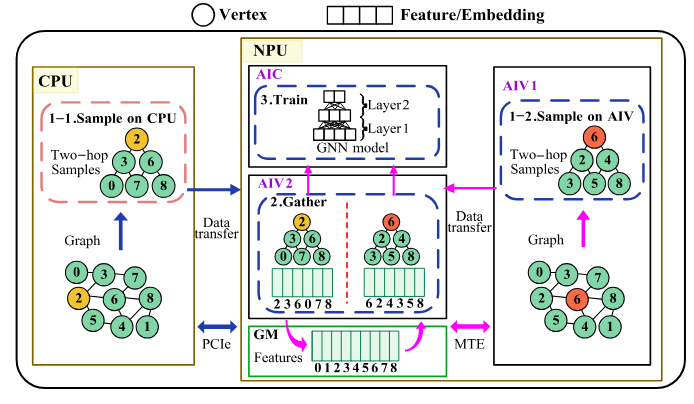
In this work, we present AcOrch, a sampling-based GNN training system optimized for CPU-NPU heterogeneous platforms. AcOrch offers fine-grained task orchestration and adopts a two-level pipelined execution model to overlap sampling, gathering, and training. It analyzes the heterogeneous compute features of NPUs and maps tasks to AI Cube (AIC) units, AI Vector (AIV) units, and CPU cores accordingly.
AcOrch: Accelerating Sampling-based GNN Training under CPU- NPU Heterogeneous Environments
Kefu Chen, Xin Ai, Qiange Wang, Yanfeng Zhang, Ge Yu
Frontiers of Computer Science (FCS) 2026
In this work, we present AcOrch, a sampling-based GNN training system optimized for CPU-NPU heterogeneous platforms. AcOrch offers fine-grained task orchestration and adopts a two-level pipelined execution model to overlap sampling, gathering, and training. It analyzes the heterogeneous compute features of NPUs and maps tasks to AI Cube (AIC) units, AI Vector (AIV) units, and CPU cores accordingly.
DepCache: A KV Cache Management Framework for GraphRAG with Dependency Attention
Hao Yuan, Xin Ai, Qiange Wang, Peizheng Li, Jiayang Yu, Chaoyi Chen, Xinbo Yang, Yanfeng Zhang, Zhenbo Fu, Yingyou Wen, Ge Yu
Special Interest Group on Management of Data (SIGMOD) 2026
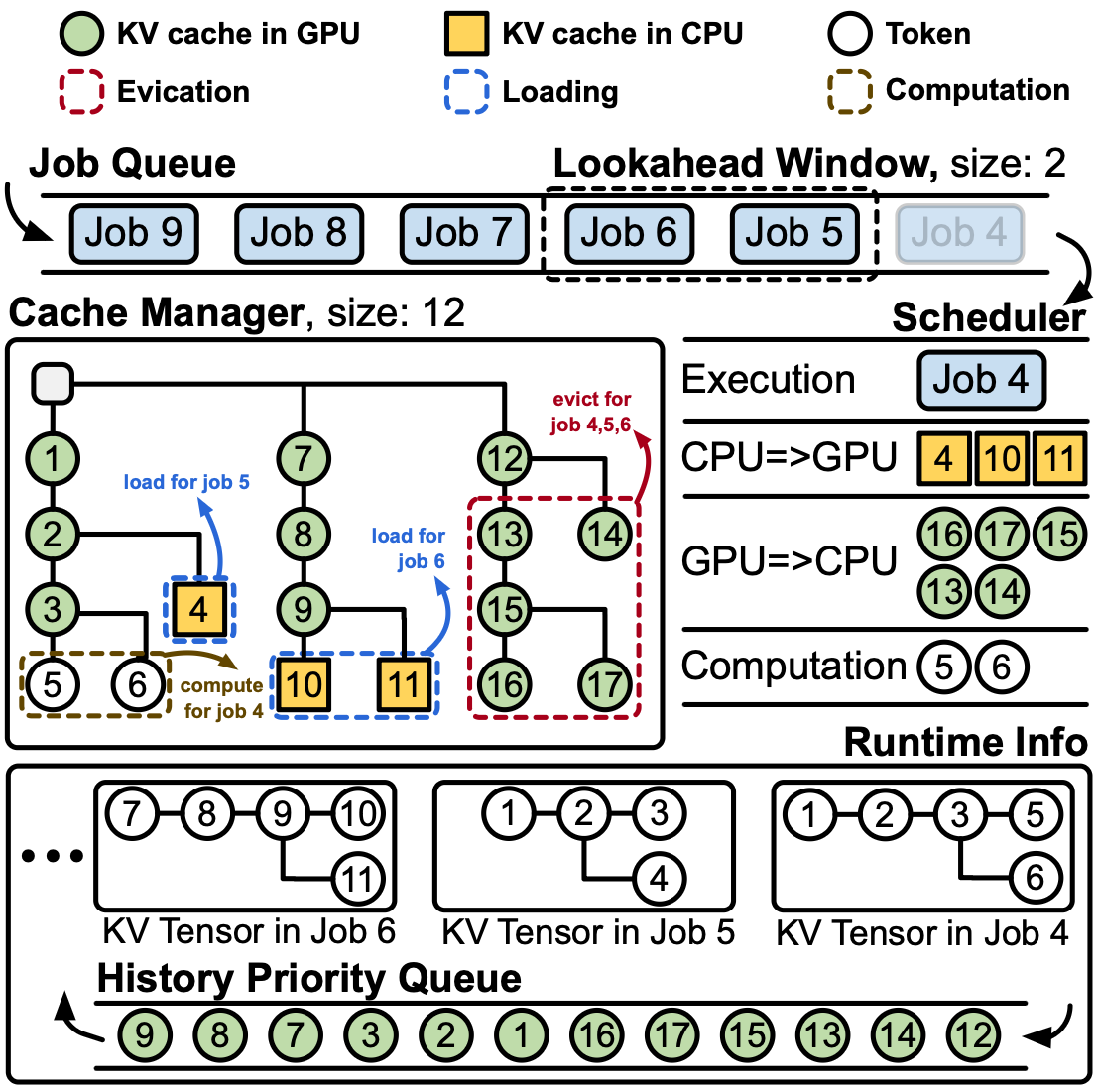
We introduce dependency attention, a novel graph-aware attention mechanism that restricts attention computation to token pairs with structural dependencies in the retrieved subgraph. Unlike standard self-attention that computes fully connected interactions, dependency attention prunes irrelevant token pairs and reuses computations along shared relational paths, substantially reducing inference overhead. Building on this idea, we develop DepCache, a KV cache management framework tailored for dependency attention.
DepCache: A KV Cache Management Framework for GraphRAG with Dependency Attention
Hao Yuan, Xin Ai, Qiange Wang, Peizheng Li, Jiayang Yu, Chaoyi Chen, Xinbo Yang, Yanfeng Zhang, Zhenbo Fu, Yingyou Wen, Ge Yu
Special Interest Group on Management of Data (SIGMOD) 2026
We introduce dependency attention, a novel graph-aware attention mechanism that restricts attention computation to token pairs with structural dependencies in the retrieved subgraph. Unlike standard self-attention that computes fully connected interactions, dependency attention prunes irrelevant token pairs and reuses computations along shared relational paths, substantially reducing inference overhead. Building on this idea, we develop DepCache, a KV cache management framework tailored for dependency attention.
NeutronHeter: Optimizing Distributed Graph Neural Network Training for Heterogeneous Clusters
Chunyu Cao*, Xin Ai*, Qiange Wang, Yanfeng Zhang, Zhenbo Fu, Hao Yuan, Mingyi Cao, Chaoyi Chen, Yingyou Wen, Yu Gu, Ge Yu (* equal contribution)
Proceedings of the International Conference on Management of Data (SIGMOD) 2026
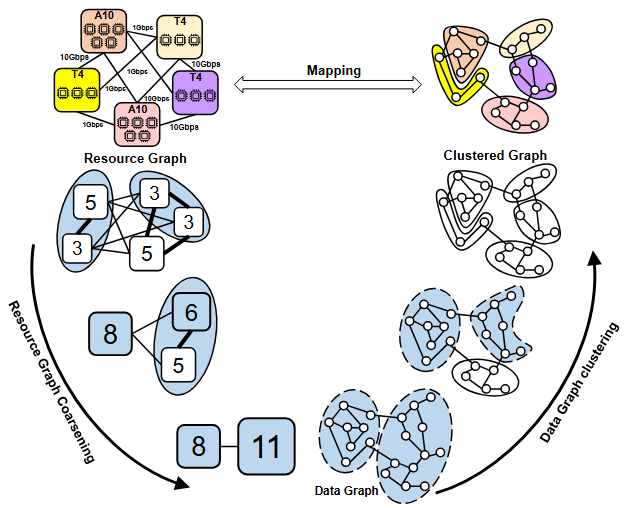
We present NeutronHeter, an efficient GNN training system for heterogeneous clusters. Our system leverages two key components to achieve its performance, including a multi-level workload mapping framework that transforms the complex multi-way mapping problem into a top-down workload mapping on a tree-like resource graph, and an adaptive communication migration strategy that reduces communication overhead by migrating communication from low-bandwidth links to local computation or high-bandwidth links.
NeutronHeter: Optimizing Distributed Graph Neural Network Training for Heterogeneous Clusters
Chunyu Cao*, Xin Ai*, Qiange Wang, Yanfeng Zhang, Zhenbo Fu, Hao Yuan, Mingyi Cao, Chaoyi Chen, Yingyou Wen, Yu Gu, Ge Yu (* equal contribution)
Proceedings of the International Conference on Management of Data (SIGMOD) 2026
We present NeutronHeter, an efficient GNN training system for heterogeneous clusters. Our system leverages two key components to achieve its performance, including a multi-level workload mapping framework that transforms the complex multi-way mapping problem into a top-down workload mapping on a tree-like resource graph, and an adaptive communication migration strategy that reduces communication overhead by migrating communication from low-bandwidth links to local computation or high-bandwidth links.
NeutronCloud: Resource-Aware Distributed GNN Training in Fluctuating Cloud Environments
Mingyi Cao, Chunyu Cao, Yanfeng Zhang, Zhenbo Fu, Xin Ai, Qiange Wang, Yu Gu, Ge Yu
Very Large Data Bases (VLDB) 2026
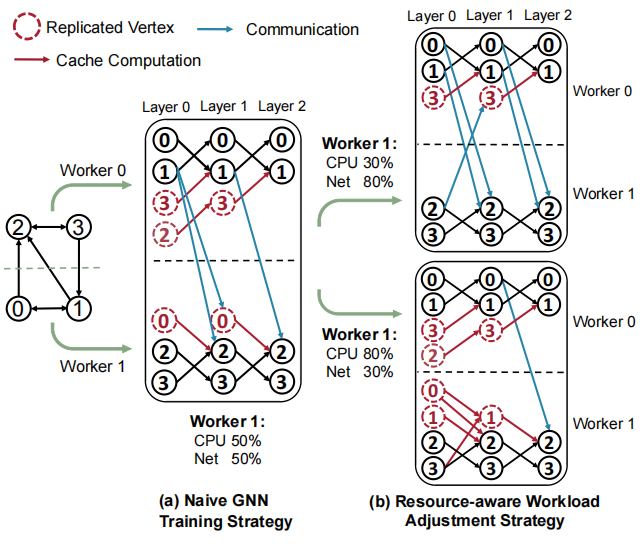
In this paper, we propose NeutronCloud, a system designed for efficient GNN training in cloud environments. First, we adopt a resource-aware workload adjustment strategy. It builds on hybrid dependency handling by obtaining dependency information through both local computation and remote communication. During training, it dynamically adjusts the ratio between locally computed and remotely fetched dependencies based on each worker's available resources, ensuring workload-resource alignment. Second, we employ a dependency-aware partial-reduce approach reusing historical vertex embeddings and skipping the stragglers during gradient aggregation to address extreme resource fluctuations that cause some workers to lag significantly behind others in the cluster.
NeutronCloud: Resource-Aware Distributed GNN Training in Fluctuating Cloud Environments
Mingyi Cao, Chunyu Cao, Yanfeng Zhang, Zhenbo Fu, Xin Ai, Qiange Wang, Yu Gu, Ge Yu
Very Large Data Bases (VLDB) 2026
In this paper, we propose NeutronCloud, a system designed for efficient GNN training in cloud environments. First, we adopt a resource-aware workload adjustment strategy. It builds on hybrid dependency handling by obtaining dependency information through both local computation and remote communication. During training, it dynamically adjusts the ratio between locally computed and remotely fetched dependencies based on each worker's available resources, ensuring workload-resource alignment. Second, we employ a dependency-aware partial-reduce approach reusing historical vertex embeddings and skipping the stragglers during gradient aggregation to address extreme resource fluctuations that cause some workers to lag significantly behind others in the cluster.
2025
NeutronAscend: Optimizing GNN Training with Ascend AI Processors
Xin Ai, Bing Zhang, Qiange Wang, Yanfeng Zhang, Hao Yuan, Shufeng Gong, Ge Yu
ACM Transactions on Architecture and Code Optimization (TACO) 2025
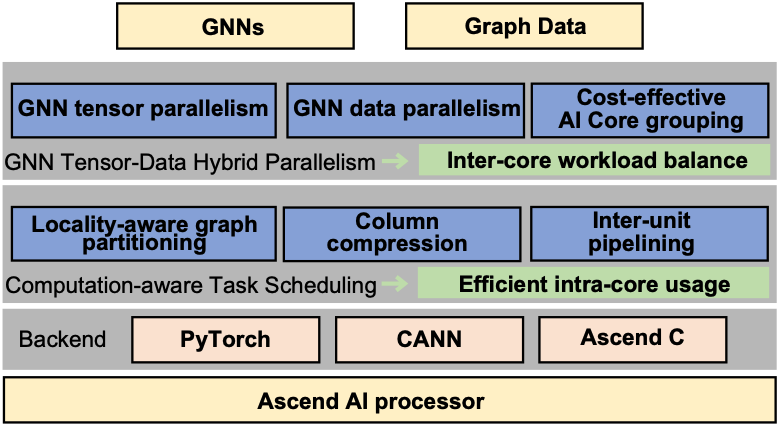
The Ascend AI processor is typically architected on multiple AI Cores that are physically decoupled and designed for dense matrix computation. When processing graph data with inherent sparsity and power-law distribution, the Ascend AI processors suffer from the inter-core workload imbalance and inefficient intra-core resource utilization. In this paper, we present NeutronAscend, an efficient GNN training framework tailored for the Ascend AI processor. NeutronAscend employs two critical designs for both inter-core and intra-core performance optimization.
NeutronAscend: Optimizing GNN Training with Ascend AI Processors
Xin Ai, Bing Zhang, Qiange Wang, Yanfeng Zhang, Hao Yuan, Shufeng Gong, Ge Yu
ACM Transactions on Architecture and Code Optimization (TACO) 2025
The Ascend AI processor is typically architected on multiple AI Cores that are physically decoupled and designed for dense matrix computation. When processing graph data with inherent sparsity and power-law distribution, the Ascend AI processors suffer from the inter-core workload imbalance and inefficient intra-core resource utilization. In this paper, we present NeutronAscend, an efficient GNN training framework tailored for the Ascend AI processor. NeutronAscend employs two critical designs for both inter-core and intra-core performance optimization.
Towards Communication-Efficient Out-of-Core Graph Processing on the GPU
Qiange Wang, Xin Ai, Yongze Yan, Yanfeng Zhang, Jing Chen, Ge Yu
IEEE Transactions on Parallel and Distributed Systems (TPDS) 2025
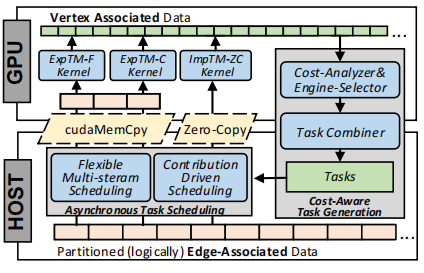
In this work, we propose a hybrid transfer management approach that takes the merits of both two transfer approaches at runtime. Moreover, we present an efficient vertex-centric graph caching framework that minimizes CPU-GPU communication by caching frequently accessed graph data at runtime. Based on these techniques, we present HytGraph, a GPU-accelerated graph processing framework, which is empowered by a set of effective task-scheduling optimizations to improve performance.
Towards Communication-Efficient Out-of-Core Graph Processing on the GPU
Qiange Wang, Xin Ai, Yongze Yan, Yanfeng Zhang, Jing Chen, Ge Yu
IEEE Transactions on Parallel and Distributed Systems (TPDS) 2025
In this work, we propose a hybrid transfer management approach that takes the merits of both two transfer approaches at runtime. Moreover, we present an efficient vertex-centric graph caching framework that minimizes CPU-GPU communication by caching frequently accessed graph data at runtime. Based on these techniques, we present HytGraph, a GPU-accelerated graph processing framework, which is empowered by a set of effective task-scheduling optimizations to improve performance.
NeutronTP: Load-Balanced Distributed Full-Graph GNN Training with Tensor Parallelism
Xin Ai, Hao Yuan, Zeyu Ling, Qiange Wang, Yanfeng Zhang, Zhenbo Fu, Chaoyi Chen, Yu Gu, Ge Yu
Very Large Data Bases (VLDB) 2025
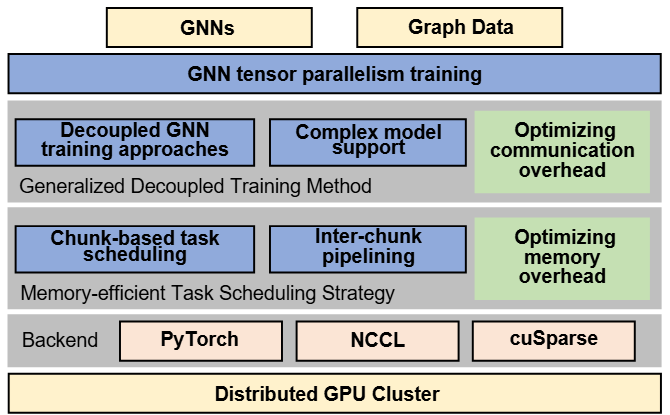
We present NeutronTP, a load-balanced and efficient distributed full-graph GNN training system. NeutronTP leverages GNN tensor parallelism for distributed training, which partitions feature rather than graph structures. Compared to GNN data parallelism, NeutronTP eliminates cross-worker vertex dependencies and achieves a balanced workload.
NeutronTP: Load-Balanced Distributed Full-Graph GNN Training with Tensor Parallelism
Xin Ai, Hao Yuan, Zeyu Ling, Qiange Wang, Yanfeng Zhang, Zhenbo Fu, Chaoyi Chen, Yu Gu, Ge Yu
Very Large Data Bases (VLDB) 2025
We present NeutronTP, a load-balanced and efficient distributed full-graph GNN training system. NeutronTP leverages GNN tensor parallelism for distributed training, which partitions feature rather than graph structures. Compared to GNN data parallelism, NeutronTP eliminates cross-worker vertex dependencies and achieves a balanced workload.
NeutronTask: Scalable and Efficient Multi-GPU GNN Training with Task Parallelism
Zhenbo Fu*, Xin Ai*, Qiange Wang, Yanfeng Zhang, Shizhan Lu, Chaoyi Chen, Chunyu Cao, Hao Yuan, Zhewei Wei, Yu Gu, Yingyou Wen, Ge Yu (* equal contribution)
Very Large Data Bases (VLDB) 2025
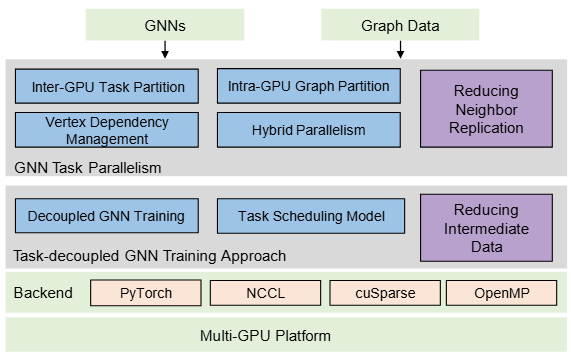
In this work, we propose NeutronTask, a multi-GPU GNN training system that adopts GNN task parallelism. Instead of partitioning the graph structure, NeutronTask partitions training tasks in each layer across different GPUs, which significantly reduces neighbor replication.
NeutronTask: Scalable and Efficient Multi-GPU GNN Training with Task Parallelism
Zhenbo Fu*, Xin Ai*, Qiange Wang, Yanfeng Zhang, Shizhan Lu, Chaoyi Chen, Chunyu Cao, Hao Yuan, Zhewei Wei, Yu Gu, Yingyou Wen, Ge Yu (* equal contribution)
Very Large Data Bases (VLDB) 2025
In this work, we propose NeutronTask, a multi-GPU GNN training system that adopts GNN task parallelism. Instead of partitioning the graph structure, NeutronTask partitions training tasks in each layer across different GPUs, which significantly reduces neighbor replication.
![NeutronRAG: Towards Understanding the Effectiveness of RAG from a Data Retrieval Perspective [Demo]](/assets/images/covers/sigmod-neutronrag.png)
NeutronRAG: Towards Understanding the Effectiveness of RAG from a Data Retrieval Perspective [Demo]
Peizheng Li, Chaoyi Chen, Hao Yuan, Zhenbo Fu, Xinbo Yang, Qiange Wang, Xin Ai, Yanfeng Zhang, Yingyou Wen, Ge Yu
Proceedings of the International Conference on Management of Data (SIGMOD) 2025
Existing RAG tools typically use a single retrieval method, lacking analytical capabilities and multi-strategy support. To address these challenges, we introduce NeutronRAG, a demonstration of understanding the effectiveness of RAG from a data retrieval perspective. NeutronRAG supports hybrid retrieval strategies and helps researchers iteratively refine RAG configuration to improve retrieval and generation quality through systematic analysis, visual feedback, and parameter adjustment advice.
NeutronRAG: Towards Understanding the Effectiveness of RAG from a Data Retrieval Perspective [Demo]
Peizheng Li, Chaoyi Chen, Hao Yuan, Zhenbo Fu, Xinbo Yang, Qiange Wang, Xin Ai, Yanfeng Zhang, Yingyou Wen, Ge Yu
Proceedings of the International Conference on Management of Data (SIGMOD) 2025
Existing RAG tools typically use a single retrieval method, lacking analytical capabilities and multi-strategy support. To address these challenges, we introduce NeutronRAG, a demonstration of understanding the effectiveness of RAG from a data retrieval perspective. NeutronRAG supports hybrid retrieval strategies and helps researchers iteratively refine RAG configuration to improve retrieval and generation quality through systematic analysis, visual feedback, and parameter adjustment advice.
2024
NeutronSketch: An in-depth exploration of redundancy in large-scale graph neural network training
Yajiong Liu, Yanfeng Zhang, Qiange Wang, Hao Yuan, Xin Ai, Ge Yu
knowledge-based-systems (KBS) 2024
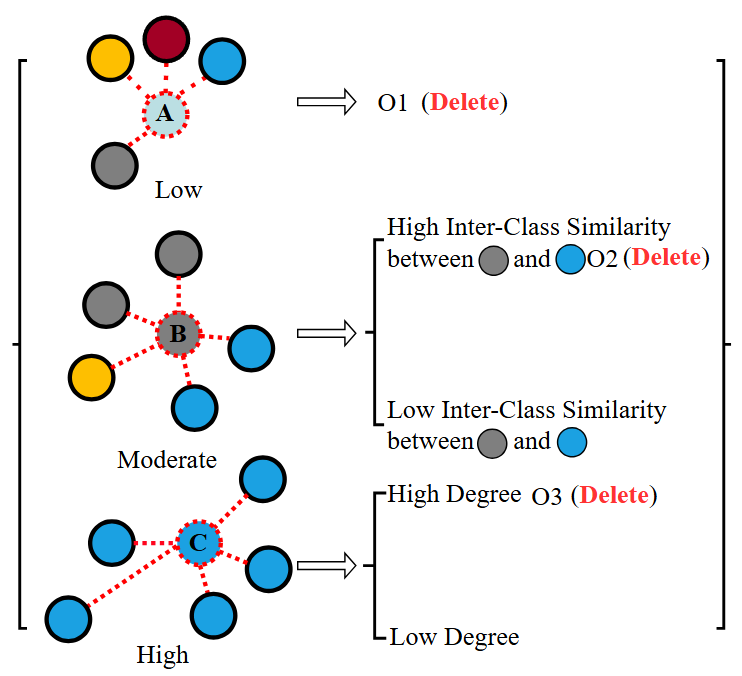
In this work, we propose a universal, one-time redundancy removal method called NeutronSketch to remove the redundant information from the input graph. This method can improve the training efficiency while maintaining the model accuracy.
NeutronSketch: An in-depth exploration of redundancy in large-scale graph neural network training
Yajiong Liu, Yanfeng Zhang, Qiange Wang, Hao Yuan, Xin Ai, Ge Yu
knowledge-based-systems (KBS) 2024
In this work, we propose a universal, one-time redundancy removal method called NeutronSketch to remove the redundant information from the input graph. This method can improve the training efficiency while maintaining the model accuracy.
NeutronOrch: Rethinking Sample-based GNN Training under CPU-GPU Heterogeneous Environments
Xin Ai, Qiange Wang, Chunyu Cao, Yanfeng Zhang, Chaoyi Chen, Hao Yuan, Yu Gu, Ge Yu
Very Large Data Bases (VLDB) 2024
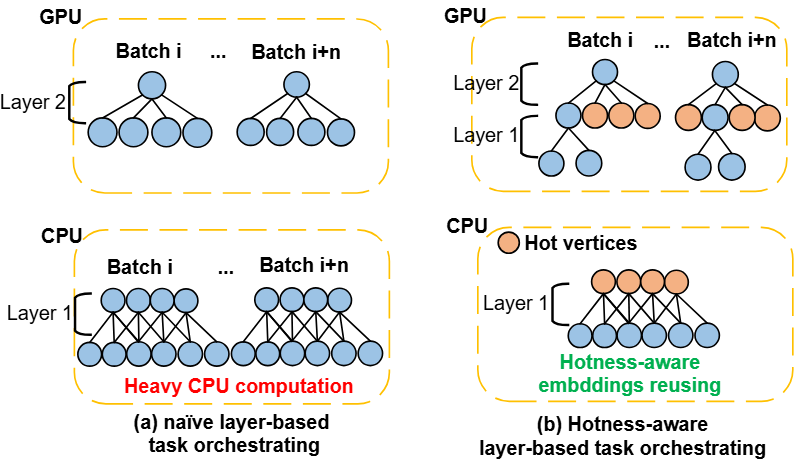
In this paper, we propose NeutronOrch, a system for sample-based GNN training that incorporates a layer-based task orchestrating method and ensures balanced utilization of the CPU and GPU. NeutronOrch decouples the training process by layer and pushes down the training task of the bottom layer to the CPU. This significantly reduces the computational load and memory footprint of GPU training.
NeutronOrch: Rethinking Sample-based GNN Training under CPU-GPU Heterogeneous Environments
Xin Ai, Qiange Wang, Chunyu Cao, Yanfeng Zhang, Chaoyi Chen, Hao Yuan, Yu Gu, Ge Yu
Very Large Data Bases (VLDB) 2024
In this paper, we propose NeutronOrch, a system for sample-based GNN training that incorporates a layer-based task orchestrating method and ensures balanced utilization of the CPU and GPU. NeutronOrch decouples the training process by layer and pushes down the training task of the bottom layer to the CPU. This significantly reduces the computational load and memory footprint of GPU training.
Comprehensive Evaluation of GNN Training Systems: A Data Management Perspective
Hao Yuan, Yajiong Liu, Yanfeng Zhang, Xin Ai, Qiange Wang, Chaoyi Chen, Yu Gu, Ge Yu
Very Large Data Bases (VLDB) 2024
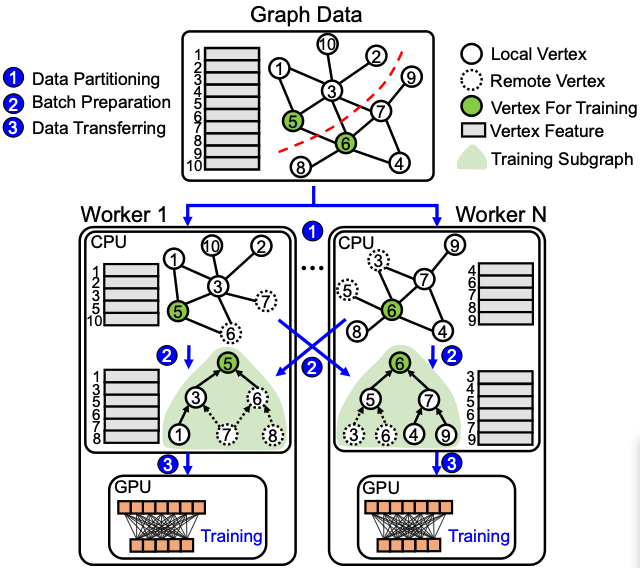
This paper reviews GNN training from a data management perspective and provides a comprehensive analysis and evaluation of the representative approaches. We conduct extensive experiments on various benchmark datasets and show many interesting and valuable results. We also provide some practical tips learned from these experiments, which are helpful for designing GNN training systems in the future.
Comprehensive Evaluation of GNN Training Systems: A Data Management Perspective
Hao Yuan, Yajiong Liu, Yanfeng Zhang, Xin Ai, Qiange Wang, Chaoyi Chen, Yu Gu, Ge Yu
Very Large Data Bases (VLDB) 2024
This paper reviews GNN training from a data management perspective and provides a comprehensive analysis and evaluation of the representative approaches. We conduct extensive experiments on various benchmark datasets and show many interesting and valuable results. We also provide some practical tips learned from these experiments, which are helpful for designing GNN training systems in the future.
2023
HyTGraph: GPU-Accelerated Graph Processing with Hybrid Transfer Management
Qiange Wang*, Xin Ai*, Yanfeng Zhang, Jing Chen, Ge Yu (* equal contribution)
International Conference on Data Engineering (ICDE) 2023
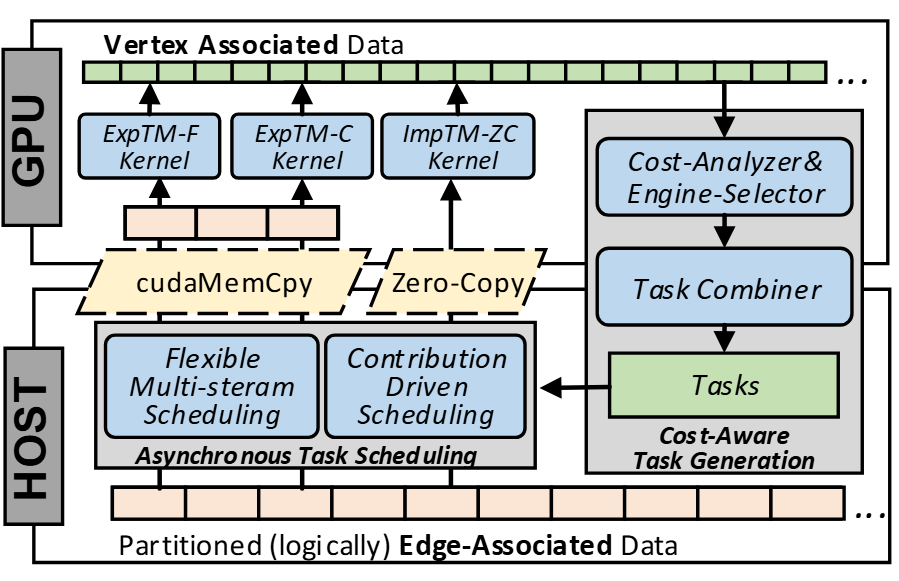
In this work, we propose a hybrid transfer management approach to take the merits of both the two approaches at runtime, with an objective to achieve the shortest execution time in each iteration. Based on the hybrid approach, we present HyTGraph, a GPU-accelerated graph processing framework, which is empowered by a set of effective task scheduling optimizations to improve the performance.
HyTGraph: GPU-Accelerated Graph Processing with Hybrid Transfer Management
Qiange Wang*, Xin Ai*, Yanfeng Zhang, Jing Chen, Ge Yu (* equal contribution)
International Conference on Data Engineering (ICDE) 2023
In this work, we propose a hybrid transfer management approach to take the merits of both the two approaches at runtime, with an objective to achieve the shortest execution time in each iteration. Based on the hybrid approach, we present HyTGraph, a GPU-accelerated graph processing framework, which is empowered by a set of effective task scheduling optimizations to improve the performance.